
Resources for Parents and Children
Resources for Parents and Children
Families faced with Lyme or other tick-borne diseases are met with unique challenges that are not always understood by medical care providers, schools, friends or even other family members. Chronic illness that can be caused by many tick-borne diseases including Lyme, Babesia, Bartonella and others can have devastating impacts to physical, emotional, social, and financial health for you, your children and your family. Parents often face challenges in supporting the education of a chronically ill child. Some children may require accommodations through a 504 plan or Individual Educational Plan (IEP) to assure educational access and success for their children. Below we have provided resources for parents and children that can be incredibly helpful in navigating these challenges.
Whether you are the parent of a sick child or a parent that is sick as well, remember that you are not alone!
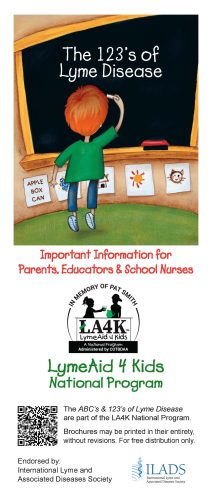
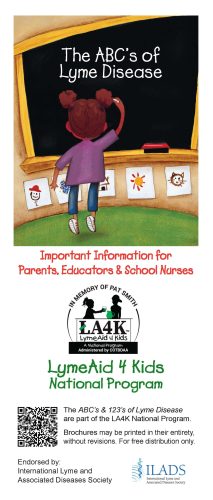 The ABC’s and 123’s of Lyme Disease Educational Brochures
The ABCs & 123s of Lyme Disease, published by the Colorado Tick-Borne Disease Awareness Association (COTBDAA) through its LymeAid 4 Kids (LA4K) National Program, are two comprehensive educational brochures designed to increase awareness, improve recognition, and expand understanding of Lyme disease and other tick-borne illnesses. Developed specifically for parents, educators, and school nurses, these resources provide important information from experts in the field to help adults recognize the signs, symptoms, and potential consequences of Lyme and other tick-borne diseases in children and adolescents. Together, the brochures offer practical educational guidance to help families and school personnel better understand how tick-borne illnesses can affect a child’s health, learning, behavior, and daily functioning. By equipping parents and educational professionals with knowledge and tools for earlier recognition, the ABCs & 123s aim to reduce delays in identification, promote informed conversations with healthcare providers, and support children whose health and educational needs may be affected by tick-borne disease. These resources are part of COTBDAA’s broader commitment to education, prevention, advocacy, and improving the lives of individuals and families affected by tick-borne illnesses. View/Download the brochures here.
Mothers Against Lyme
mothersagainstlyme.org
We are mothers, and mother-advocates, concerned with the impact of Lyme Disease and its co-infections on pregnant women, children and families. COTBDAA President, Monica White, is a founding member of this organization.
 Finding Resilience: A Teen’s Journey Through Lyme Disease
resilientlyrachel.com
At 13 years old, Rachel was diagnosed with Lyme disease and spent the next three years bedridden and in a wheelchair, in intense, body-wide pain while her family searched for answers. Now, in her 30s, Rachel has co-written the book “Finding Resilience: A Teen’s Journey Through Lyme Disease,” with her mother, Dorothy Kupcha Leland, sharing how battling Lyme disease can look from both the perspective of a teenager and a parent.
When your Child has Lyme Disease: A Parents’ Survival Guide
lymeliteratepress.com
This book by Sandra Berenbaum, LCSW and Dorothy Kupcha Leland is filled with valuable information that parents need to know about Lyme to help navigate and cope with the complexities of this illness for their children. You may also visit the authors at Facebook page at: facebook.com/WhenYourChildHasLyme
The Lyme Times
lymedisease.org
LDO advocates nationally for quality accessible healthcare for patients with Lyme and other tick-borne diseases. Two special issues of the Lyme Times publication of particular interest to parents are the Lyme Times “Children’s Treatment Issue” and The Lyme Times “Children’s Education Issue”. Together they provide a comprehensive overview of issues facing children with tick-borne disease, with proposals for solutions in many areas. Joining LymeDisease.org allows access to these valuable resources and other tools that can assist patients in navigating this complex disease.
Lyme Family Resources
Sandy Berenbaum, LCSW, BCD, Lyme-Literate Psychotherapist
“Lyme disease can be a debilitating illness having a profound effect on interpersonal relationships and a patient’s ability to function at home, in school, and in the workplace. Making matters worse, most chronic Lyme patients suffer from delayed or inaccurate diagnoses prior to finding a doctor who will treat their illness effectively. Some patients have spent months or even years trying different treatments that don’t work, since their diagnosis was, in fact, wrong. Patients often feel isolated and trapped when those around them do not understand the complexity of their illness and what they are experiencing.” Sandy provides resources for parents, educators and children dealing with these complexities of Lyme in the family and the schools. Visit lymefamilies.com for more information and to download the valuable resources below:
- BOUNDARIES 101 FOR LYME PATIENTS: When chronic Lyme disease patients are diagnosed, they enter a different world. The lack of understanding of the complexities of this illness outside of the Lyme community makes it important for patients and families with Lyme disease to establish boundaries, to set limits with those around them who do not understand what they are going through, to protect their time and energy, and to get the support they need. Here I discuss the boundary issues, and offer strategy for dealing with these issues when they come up.
- KIDS AND LYME DISEASE: HOW IT AFFECTS THEIR LEARNING: Lyme disease can have a profound affect on a child’s ability to learn. This article discusses the complexity of the problems that children with chronic Lyme face in the school environment and what can be done to support them.
- TICK-BORNE DISEASE IN CHILDREN AND ADOLESCENTS: A MEDICAL ILLNESS/A MULTIDISCIPLINARY “CURE”: Lyme is a complex illness that, when chronic, often effects the brain, causing impairments in mood, cognition and attention. An integrated, or team approach to treating Lyme patients can provide help, support, and solutions to problems generated by the illness, beyond the medical treatment itself.
- REFLECTIONS ON LYME DISEASE IN THE FAMILY: Lyme disease in a child or adolescent can have a profound effect on a family. This article touches on some of the issues that face parents and offers parenting strategies to help ease the journey.
- LYME DISEASE SCREENING PROTOCOL: This is a simple screening tool designed to help mental health practitioners determine whether Lyme disease could be an underlying cause of presenting problems among children or adolescents. My hope is that by using this tool, more cases of Lyme disease may be recognized by mental health practitioners, resulting in earlier medical diagnosis and the need for less complex and lengthy treatment. If a tick-borne illness is present, comprehensive medical treatment can lead to more successful resolution of mental health problems, as well.
- IDENTIFYING LYME DISEASE IN THE SCHOOLS: Education regarding Lyme disease is an important service we can provide to our schools. This handout can help teachers, nurses and guidance counselors identify children who may have Lyme, leading to early diagnosis and treatment. Since Lyme disease can have a profound impact on a child’s ability to learn, school professionals have a different view of the child than the parents or pediatrician might.
Gifted Students and Lyme Disease: What Educators, Counselors and Parents Need to Know
Patricia A. Schuler
Author of the article “Gifted Students and Lyme Disease: What Educators, Counselors, and Parents Need to Know” , an invaluable resource when trying to both nurture and accommodate a gifted student with Lyme in the education system. Patricia provides resources for both parents and educators to best meet the needs of gifted students You may request a full text of this article at researchgate.net

Ultraparent Thinking
ultraparentthinking.com
Written by Anna Brennan,a mother with Lyme disease that has raised four children with Lyme disease. Encouragement and resources to pull from for parents to develop the inner strength necessary to care for a child with health issues.
 Little Bite BIG TROUBLE A Bird’s Eye View of Lyme Disease
lymevoice.com
Author, Mom, Lyme patient and advocate, Sarah Schlichte Sanchez tells a beautiful story filled with understanding, compassion and hope for young children and families faced with the unique challenges of Lyme and chronic disease. Visit Sarah’s other resources at lymevoice.com.
Infection Associated Neuropsychiatric Conditions
Infection-Associated Neuropsychiatric Conditions (IANCs) represent a critical and largely overlooked public health crisis, with profound and often life-altering consequences for children, adolescents, adults, and families across the United States. These complex conditions can trigger significant disruptions in brain function, mood, behavior, and cognition as a result of infection or the body’s immune response. They encompass Pediatric Acute-onset Neuropsychiatric Syndrome (PANS), Pediatric Autoimmune Neuropsychiatric Disorders Associated with Streptococcal Infections (PANDAS), and neuropsychiatric manifestations associated with Lyme disease, Bartonella and others. PANS, is an encephalitic-type autoimmune disease that can be induced by different infections/illnesses: strep throat (PANDAS) mycoplasma, pneumonia, flu and/or Lyme Disease and Bartonella.
It is important that pareents and physicians recognize that Lyme and other tick-borne diseases can lead to neuropsychiatric symptoms like depression, anxiety, and cognitive issues, often mimicking primary psychiatric disorders, and that sometimes neuropsychiatric/cognitive symptoms may be the only symptoms of a tick-borne infection. Infection associated neuropsychiatric symptoms may include hyperactivity, rage, sudden mood changes, irritability, easy tearfiulnes, increased PMS symptoms, ADHD, memory issues, and more. Sleep disturbances are also common. These symptoms can emerge early or late in the disseminated phase of infection, and may be refractory to conventional psychiatric medications. Patients often face delayed recognition, misdiagnosis, fragmented care, limited treatment options, and persistent symptoms despite conventional treatment approaches. Read the IANC White Paper published in partnership by National Alliance for PANS/PANDAS Action (NAPPA) and the Center for Lyme Action.
Sites below are sources of information and support for educators, school nurses, physicians, and parents with children impacted by Pediatric Acute-Onset Neuropsychiatric Syndrome.
Additional Resources
For additional resources in understanding the complexities of Lyme and other tick-borne infections and the tools to navigate these illnesses visit: